Europe's AI Anxiety Grows as Global Tech Summit Lands in France
Background
AI has become a central pillar of digital economies, powering everything from search engines to autonomous vehicles. In recent years, the United States has tightened export rules for advanced semiconductors and AI software, citing national security concerns. Europe, meanwhile, has pursued its own AI strategy through the European AI Act and massive public‑private funding programs. The latest restriction on Anthropic’s models adds a new layer to an already complex transatlantic relationship, raising questions about how Europe can maintain competitiveness while adhering to its regulatory ambitions. The move also signals a broader shift toward protectionism in technology, prompting European policymakers to reassess their reliance on foreign AI providers.
Introduction
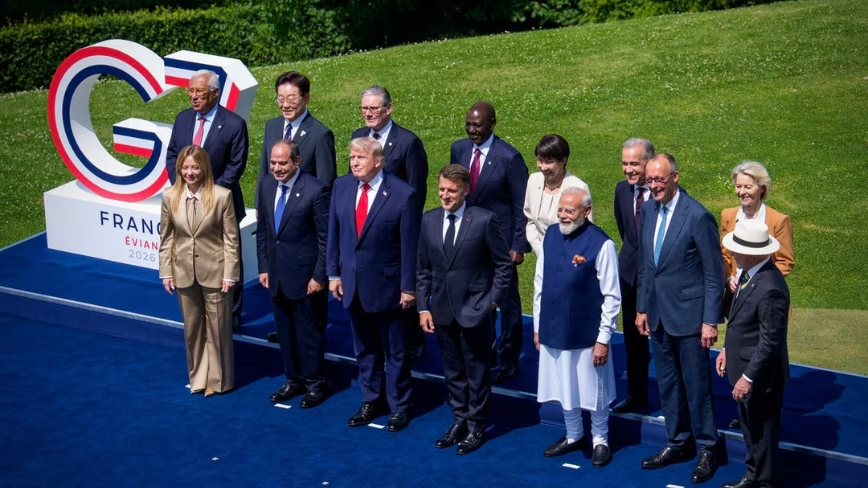
The United States recently announced tighter controls on access to Anthropic’s most advanced language models. The decision arrived just as Paris prepared to host VivaTech, a major European tech gathering, and as G7 leaders gathered at Evian-les-Bains for their summit. The timing underscored a growing unease across Europe about dependence on American AI technologies and the geopolitical implications of such dependencies.
The US Move
Washington’s restriction limits the ability of researchers, startups, and large firms outside the United States to integrate cutting‑edge AI capabilities into their products. The policy reflects concerns about the strategic advantage of foreign actors and the potential misuse of powerful models. While the exact scope of the controls remains under discussion, the signal to the international community is clear: the United States intends to keep a tighter grip on its leading AI assets.
Why Europe Is Worried
European nations have built much of their digital infrastructure on services and models developed by a handful of U.S. companies. This creates several challenges:
- Sovereignty – reliance on external providers can compromise national security and data protection goals.
- Economic competitiveness – startups may find it harder to access the same tools as their American counterparts, widening the innovation gap.
- Regulatory alignment – differing standards between continents can create friction for cross‑border data flows.
Policymakers in Brussels and capitals across the Union have therefore called for accelerated investment in domestic AI research, stronger data‑localization measures, and a more assertive stance in international AI governance.
VivaTech and G7: A Stage for Dialogue
VivaTech, expected to draw over 180,000 participants, offers a platform for European innovators to showcase home‑grown solutions. Simultaneously, the G7 summit provides a diplomatic arena where leaders can address the broader implications of AI competition. Both events are likely to feature discussions on:
- Establishing common ethical frameworks for AI deployment.
- Creating pathways for shared research while protecting intellectual property.
- Balancing openness with security concerns.
The convergence of these gatherings amplifies the urgency of finding a coordinated European approach.
Possible European Responses
In response to the U.S. restrictions, Europe may pursue several strategic avenues:
- Boost public‑private partnerships to fund large‑scale AI projects that rival private‑sector capabilities.
- Encourage open‑source development as a way to democratize access to advanced models and reduce vendor lock‑in.
- Negotiate new trade agreements that include provisions for AI technology transfer and reciprocal access.
- Introduce regulatory incentives for companies that prioritize European‑based AI components.
Each path carries trade‑offs. Public investment can accelerate progress but may strain budgets, while open‑source initiatives risk fragmented ecosystems. The key will be a balanced mix that preserves Europe’s strategic interests without isolating the continent from global innovation.
Implications for Global AI Governance
The friction between Washington and Brussels over AI access reverberates beyond Europe’s borders. It pressures other nations to choose between aligning with U.S. standards or fostering independent AI ecosystems. The situation also accelerates discussions within multilateral bodies such as the OECD and the United Nations about creating shared safeguards for high‑risk AI. Moreover, the debate may inspire new alliances, for example between Europe and Asian partners seeking to balance American influence. In this fluid environment, the ability to set common norms will determine which actors shape the future of AI.
Takeaway
The tightening of U.S. AI access, arriving on the heels of major European tech events, highlights a pivotal moment for the continent’s digital future. Europe must navigate between safeguarding sovereignty and remaining an open participant in the global AI ecosystem. Success will depend on coordinated policy, sustained investment, and a clear vision for how AI can serve both economic growth and societal values.